

With this year’s COP once again failing to meet expectations for rapid transition to a post-fossil fuel future, surely a more effective and urgent approach is required? Elizabeth Boulton argues for a Plan E that would harness global cooperation to see off humanity’s common ‘hyperthreat’ of planetary breakdown.
Despite the meagre outcomes of past global climate Conferences of the Parties (COP), the ubiquitous presence of the fossil fuel industry, the fatal clanging sound of climate records breaking in fast succession over 2023, and the widening chasm between ‘The West’ and ‘The Rest’, the fact that COP28 occurred at all, offered some consolation to a global population shaken by recent surges in warfare.
The sight of world leaders talking about safeguarding life contrasted to the harrowing imagery of dead children being pulled from the rubble in Palestine. It reminded that humans can solve problems through dialogue rather than warfare.
Even so, humanity regarded the powerful and chosen of the world, 70,000 of them in Dubai this month for COP28, with bruised hearts and scepticism. Looming over proceedings was James Hansen’s warning that global warming will hit harder and faster than previously understood. Meanwhile, Scientists’ Rebellion reminded that “the IPCC pathway for staying below the 1.5°C climate goal is now considered implausible.”
COP28 – Show me the money
Against this grim backdrop, in its first week, COP28 took some dogged steps forward, with a focus upon establishing a financial framework to support energy transition. Overall, over $83 billion was pledged to support climate response initiatives, which includes $792 million for a loss and damage fund. Food security announcements were applauded by the humanitarian sector. The ‘peace day’ saw a declaration, (voluntary and not legally binding) on ‘climate, relief, recovery and peace’ which also had a financial orientation.
The equitable use of such funds remains to be seen, while the amounts pledged contrast with the global oil and gas industry’s annual profits ($4 trillion in 2022), annual global fossil fuel subsidies ($7 trillion in 2022) and the COP15 goal to mobilise $100 billion per year.
Is this as good as it gets?
COP28’s final text and result was perhaps best described by Colombia’s representative as reflecting ‘political reality’ rather than the COP process itself. There were some small wins, such as for the first time making a commitment to transition away from fossil fuels (see para 28(d).) Most developed nations described COP28 as achieving an incremental (not transformational) step forward, while small island states like Samoa and the Marshall Islands were disappointed by the “leaky canoe” which has many worrying loopholes. Bolivia accused developed nations of hypocrisy and perceived that progress was regressing, not progressing.
There was, however, a sense that the goodwill among most attendees, (the ‘Climate love’ as the Zambian representative described it) rekindled some faith in multilateralism. While COP28 offers a platform that could help launch transformational change, it is far from guaranteeing it. It remains the case that large-scale transformational change is essential to alter the current trajectory towards a Hot House Earth pathway.
An enduring problem is that, although the IPCC advises that to avoid dangerous climate change no new fossil fuel development can occur, (a viable pathway according to a 2021 IEA report – see page 21), the UNEP reports that:
“…governments plan to produce around 110% more fossil fuels in 2030 than would be consistent with limiting warming to 1.5°C, and 69% more than would be consistent with 2°C.”
UNEP Emissions Gap Report 2023
There are still no institutional mechanisms to prevent further fossil fuel development. Overall, the magnitude and mechanics of an energy and ecological transformation remain formidable, and it is a high-stakes gamble to see if new financial support mechanisms allow a market-led solution to arise.
What else can be done?
Such problems are leading to discussion about ‘what else can be done?’ Prominent climate scientist Michael Mann encourages people to work to mend, not end the broken COP process. Journalist George Monbiot suggests changing COP voting methods or Professor Anthony Burke’s idea of shifting to a treaty-based approach. In general, a recent paper identifies that there is a lack of research on alternatives to the COP process. However, the authors missed research sitting outside the scientific field.
PLAN E – an alternate approach
Humanity does have another option, which is complementary to the 2015 Paris Agreement mandate, not oppositional, and could occur parallel to an evolving COP process. It is an approach which provides a framework for responding to a threat, which is no longer hypothetical, but now manifesting.
This new approach asks, if the living planet does face a catastrophic threat of almost total annihilation, why not treat it akin to how other historic major threats have been treated? In other words, could the prevailing body of military theory (thousands of years of warfare studies) on ‘how’ to respond to overwhelming, destructive threat, in short time frames, be applied, in modified way – informed by eco-philosophy – to the planetary security context? The result is an answer to King Charles’ 2020 call for a ‘Marshall Plan’ like response.
‘PLAN E’ is a climate and ecologically centred security strategy, or a concept for a ‘HyperResponse’ to the planetary crisis. The problem is moved from the policy sphere to security sphere. The arguments for why it is time for a fundamental shift in how humanity perceives and approaches security are expanded upon in an accompanying theoretical article and in Chapter 15 of a new book, ‘Hot War.’
The approach hinges upon two key new concepts.
Hyperthreat
The first concept is understanding that the interconnected climate and ecological crises are not merely scientific, economic, or routine governance matters, nor are they a time-limited crisis or emergency. Rather, climate and ecological breakdown presents a new form of violence, killing, harm and destruction beyond anything humanity has ever encountered before, which I describe as a hyperthreat. Further, the hyperthreat is not a ‘hazard’ (randomly occurring), but like what Rob Nixon terms ‘slow violence’, it involves new forms of conscious intent to cause harm.
Entangled Security
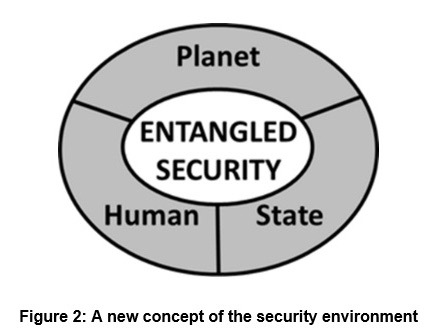
The second concept is what I call ‘Entangled Security’, which regards planetary, human, and state security as being inherently interconnected (Figure 2). It no longer makes sense to separate planetary security from human or state security matters, as current global institutional approaches require.

Figure 1: The entangled security environment of the 21st Century
Applying new conceptual tools
Analyzing the hyperthreat in the context of an entangled security environment allows a disturbing picture of strategic incoherence to emerge. Immediately it became obvious that warfare, or preparation for major warfare, only serves to strength humanity’s new foe – the hyperthreat. War increases GHG emissions; new weaponry will devastate fragile ecological systems, while preparation for major war, let alone conduct of one, would fatally derail resources and focus from the urgent energy and ecological transformation. In other words, now, warfare does not deliver security; it undermines security. The logic of industrial era security strategy is now at odds with planetary survival. However, the analysis also finds that the opportunity for reconfiguration and realignment is extraordinary.
HyperResponse
The HyperResponse is envisioned as a civil-led, whole-of-society mobilisation (not militarisation). It hinges upon establishing a global Planetary Peace Treaty, which would allow all nations to focus upon containing and countering the Hyperthreat. There are six phases, as depicted in Figure 2.

Figure 2: HyperResponse Phases
As the HyperResponse has a bottom-up and localisation focus, one year is allocated to supported, deliberate planning across all levels of society. This contrasts to the COP approach, where the bulk of humanity is sitting on the sidelines and where relatively small numbers of people have merely two weeks to discuss, analyze and decide on complex matters.
The ‘Hyper Response Force’ (HRF) would raise two new significant task forces, each of which are comparative to the size of existing militaries. These are the planetary and human security task forces. They comprise new capabilities such as a ‘wake force’ (which has a human security focus) and ‘eco-rebuild squads’.

Figure 3: Concept for a Hyper Response Force
How does it address the shortfalls of the COP28 process?
As a security mission, the HyperResponse would have the authority to curtail powerful economic actors whose actions imperil planetary security.
In terms of resourcing the HyperResponse, penalising polluters, stopping fossil fuel subsidies, demilitarisation, and repurposing of defence industry would all provide an injection of revenue, engineering, and technical expertise to the planetary care problem, which currently seems insurmountable.
How could a HyperResponse gain a mandate?
PLAN E anticipates the civil sector requesting a new security plan from their governments but doesn’t stipulate how this might occur. There is a range of possibilities.
One way would be to link Plan E to broader discussions about UN reform to match the needs of a multi-polar world. Given the significance of 2023 scientific warnings; the lack of suitable progress at COP28 (but goodwill among many nations to act more strongly), escalations towards major war, and widespread deterioration of human security, the full ‘entangled security’ crisis issue could be referred to a revamped UN Security Council, or to all UN member states. A crisis meeting could be called for all nations, (not corporations or lobbyists), with an invitation to participate in a ‘Planetary Peace Treaty’, to extend for at least ten years. This treaty, effectively a global ceasefire, would aim to allow all nations to focus on countering and containing the hyperthreat.
A second option would be for citizens to pursue an approach outside the UN. A civil-led process could leverage off existing climate emergency declarations; calls for a fossil fuel non- proliferation treaty or Extinction Rebellion’s Citizens’ Assembly on Climate and Ecological Justice proposal. To take an ambitious civil-led approach, decision making could be withdrawn from officials and shifted to the global population – to every person aged 12 or above. If the global population voted for a ceasefire, this could help give the world the mandate it needs to effect change.
A third possibility is reform at the national level. If PLAN E is socialised with the public, and supported, this might lead nations to independently revise their security, climate, and environmental strategies. Governments might begin by, at least, initiating whole-of-society contingency planning for an emergency response.
A fourth approach links to national response and de-globalisation trends, such as the rise of the BRICS, the decline of UN authority and legitimacy, and the sharpening divide between ‘the west’ and ‘the rest.’ Nations could pursue entangled security objectives through smaller, regional, or more trusted groups of nations. Thus, future COP-like events, or general ‘entangled security’ planning would occur within regional blocks. Small numbers of national and /or ‘block’ representatives (of around 20 to 100) would work on the global dimension of agreements.
The fifth option is to wait for the planetary crisis to become so severe that suffering population groups then demand rapid response. A reactive approach such as this could be too late to meaningfully address planetary breakdown. However, having ‘PLAN E ‘on the shelf’ may help humanity endure and survive better or longer than they may otherwise have been able to do.
In conclusion, COP28 representatives seem to want success and rapid climate action, but lack new ideas about how to better enable such transformation. In this context, PLAN E might be worth a closer look.
The views and opinions expressed in posts on the Rethinking Security blog are those of the authors and do not necessarily reflect the position of the network and its broader membership.
Image Credit: Banner Image: NIFC via Wikipedia; A wildfire on the East Fork of the Bitterroot River on the Sula Complex in the Bitterroot National Forest in Montana, United States. Figures 1-3: Elizabeth Bourne.


Very interesting thoughts